


Tacky mats are multilayer adhesive floor protection systems designed to remove airborne particles, dust, and particulate contaminants from footwear and cart wheels before entering controlled areas. In cleanroom contamination control programs, tacky mats reduce particle migration between zones by using pressure-sensitive adhesive layers with controlled tack strength, layer replacement frequency, and measurable particle capture performance.
For semiconductor, pharmaceutical, medical device, and precision manufacturing facilities, tacky mats are installed at transition points between non-controlled and controlled areas to support ISO 14644-1 cleanroom classification requirements. Their effectiveness depends on adhesive formulation, polyethylene film structure, particle removal efficiency, and correct placement within the contamination control process.
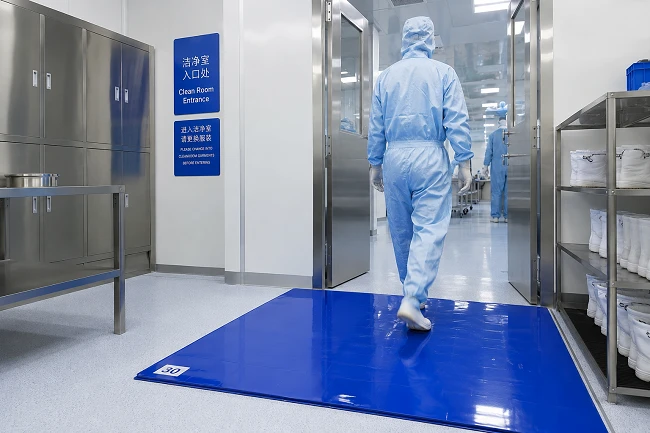
Cleanroom tacky mat installed at entrance for contamination control in semiconductor facility
Tacky Mats as a Contamination Control Barrier in Multi-Zone Cleanrooms
Modern controlled environments normally include multiple cleanliness zones:
- General production area
- Gowning room
- Air shower area
- ISO Class 7–8 production zones
- ISO Class 5 critical process areas
Each transition point creates a contamination transfer risk. Footwear soles and transport wheels can carry particles including:
- Fibers
- Metal particles
- Plastic fragments
- Dust
- Process residues
A tacky mat provides a physical capture surface before contaminants enter higher cleanliness areas.
The contamination control process typically combines:
- Personnel gowning procedures
- Air shower systems
- Cleanroom wipes and surface cleaning
- Tacky mat particle removal systems
For integrated contamination management, refer to Contamination Control solutions used in controlled environments.
IEST-RP-CC004.3 Guidelines: Tacky Mat Performance Factors in Cleanroom Applications
According to cleanroom contamination control practices referenced by Institute of Environmental Sciences and Technology guidelines, adhesive floor mats should be evaluated based on particle removal capability, residue control, and compatibility with cleanroom operations.
Key technical parameters include:
| Parameter | Typical Specification Range | Impact on Cleanroom Performance |
|---|---|---|
| Material | Low-density polyethylene (LDPE) film | Provides flexible particle capture surface |
| Layers | 30 / 60 layers | Determines replacement cycle |
| Thickness | Approx. 35–40 μm per layer | Controls durability and handling |
| Adhesive strength | Customized tack level | Balances particle removal and footwear comfort |
| Surface condition | Low residue adhesive | Prevents transfer contamination |
| Color options | Blue, white, gray | Supports contamination visibility |
A properly selected tacky mat should remove particles without leaving adhesive residue on shoes, wheels, or cleanroom floors.
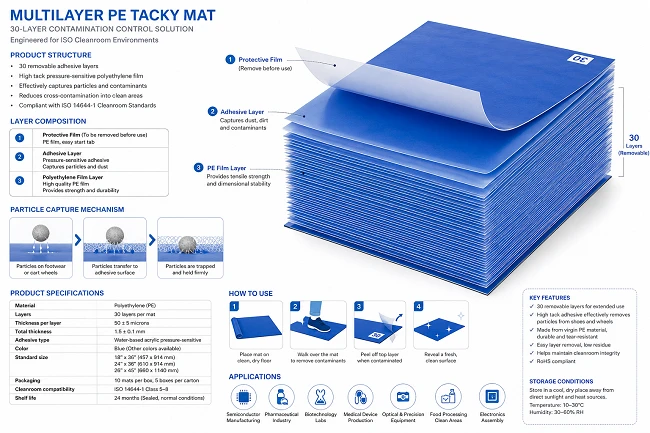
Request Bulk Pricing For PE Tacky Mats From Us
Xiamen Qianyu Technology supplies tacky mats for global cleanroom distributors, semiconductor factories, and OEM procurement programs.
Available specifications include:
| Specification | Available Options |
|---|---|
| Layer count | 10, 30, 60 layers |
| Standard sizes | 18"×36", 18"×45", 24"×36", 26"×45" |
| Thickness | 3.5C and customized options |
| Adhesive level | Standard / high tack |
| Packaging | Individual bags, cartons, OEM packaging |
| Production | Bulk manufacturing and private label supply |
As a China manufacturer, we support:
- Wholesale orders
- OEM/ODM production
- Custom sizes
- Custom adhesive levels
- Export packaging requirements
ISO 14644-1 Controlled Environment Applications: Semiconductor and Pharmaceutical Use Cases
Semiconductor Manufacturing
Semiconductor production requires strict particle control because particles above several microns can affect wafer yield.
Common applications:
- Wafer fabrication entrances
- Equipment maintenance zones
- Material transfer areas
- ESD-controlled rooms
Tacky mats help reduce footwear-generated particles before entering critical areas.
Pharmaceutical Manufacturing
Pharmaceutical facilities use tacky mats to control environmental contamination during:
- Raw material transfer
- Filling operations
- Packaging processes
- GMP production workflows
The adhesive surface helps reduce particulate transfer from personnel movement.
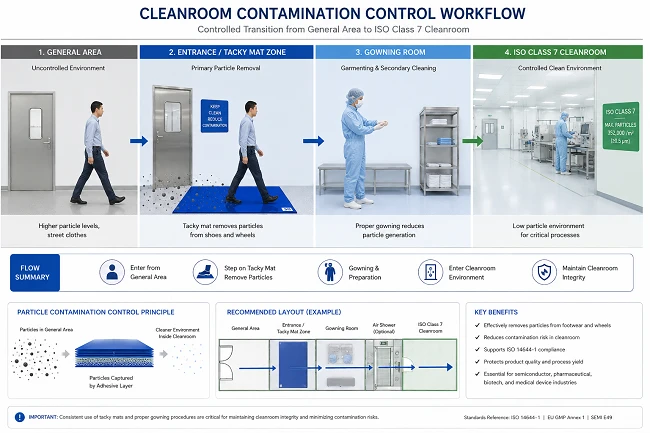
Cleanroom zoning diagram showing tacky mat use for cross-contamination prevention
IEST-RP-CC003 / ISO 14644-1 Cleaning Process Integration
Tacky mats should be integrated with a complete cleaning system rather than used as a standalone control method.
A typical contamination control workflow:
| Step | Product/System | Function |
|---|---|---|
| 1 | Cleanroom garment | Reduce human particle shedding |
| 2 | Tacky mat | Remove footwear contamination |
| 3 | Cleanroom wipes | Remove surface particles |
| 4 | HEPA filtration | Control airborne particles |
This combination supports stable particle levels during daily cleanroom operation.
FAQ: Tacky Mat Procurement Questions
Q1: What is the MOQ for bulk tacky mats?
Standard sizes are available from bulk quantities. OEM sizes and customized packaging require MOQ confirmation based on production requirements.
Q2: Can tacky mats be customized with different sizes or adhesive levels?
Yes. Size, layer number, adhesive strength, color, and packaging can be customized for distributor and cleanroom projects.
Q3: Do you support factory audits for cleanroom product sourcing?
Yes. Factory audits, quality documentation review, and production verification can be arranged for qualified B2B customers.