


As a dedicated manufacturer, we understand that the "better" wipe isn't necessarily the most expensive one-it is the one that aligns with your specific ISO class requirements and the nature of your surface tasks.
1. Material Structure: The Core Difference
To understand performance, we must look at how these fabrics are constructed.
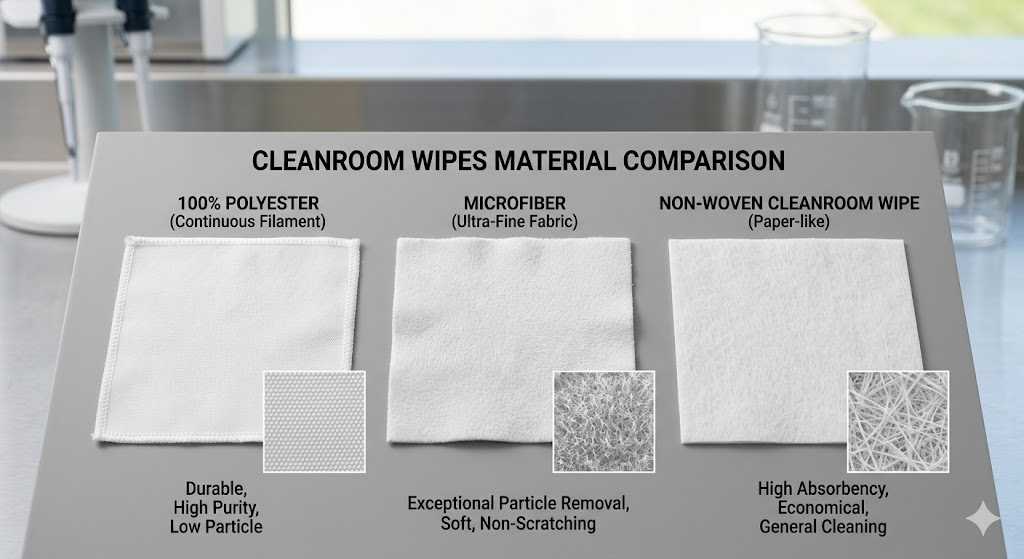
Non-Woven Wipes: Typically made from a blend of polyester and cellulose or melt-blown polypropylene. These are created by bonding fibers together mechanically, thermally, or chemically rather than weaving them.
Knitted Wipes: Usually 100% continuous filament polyester. These are "knitted" into a stable interlocking structure, which inherently provides more strength and durability.
2. Low-Linting and Particle Generation
In a controlled environment, the primary goal is to minimize foreign object debris (FOD).
Knitted Wipes (The Gold Standard for Low Particles)
Because knitted wipes use continuous filament yarns, there are very few "ends" to break off and become lint. When these wipes are laser-cut or ultrasonic-sealed at the edges, they become the ideal Lint Free Wipes for ISO Class 4 and 5 environments. They are incredibly robust and won't snag on rough surfaces, which prevents fiber shedding during heavy scrubbing.
Non-Woven Wipes (Cost-Effective but Higher Risk)
Non-woven materials are often "hydro-entangled." While they are processed to be clean, the short fibers (especially in cellulose blends) are more prone to breaking away under friction. These are best suited for ISO Class 6 or 7 environments where absolute zero-lint performance is less critical than cost-efficiency.
3. Absorbency and Wiping Efficiency
How a wipe handles liquids is the second most critical factor in choosing your supply.
| Feature | Non-Woven (Polyester/Cellulose) | Knitted (100% Polyester) |
| Initial Sorp Rate | Very Fast | Moderate (unless treated) |
| Liquid Capacity | High (due to cellulose) | High (due to interspace) |
| Best Used For | General spill pickup | Precision cleaning/Disinfecting |
Non-woven wipes are the "sponges" of the cleanroom world. The cellulose component acts as a wick, drawing in liquids almost instantly. If your priority is quickly soaking up a large spill, non-woven is often the superior choice.
Knitted wipes offer excellent sorptive capacity but may have a slightly slower initial "grab." However, their advantage lies in purity. Because they are 100% synthetic, they release almost no extractables (chemicals) into the solvent, ensuring that the surface is truly clean after the wipe-down.
4. Factory Perspective: Which Should You Choose?
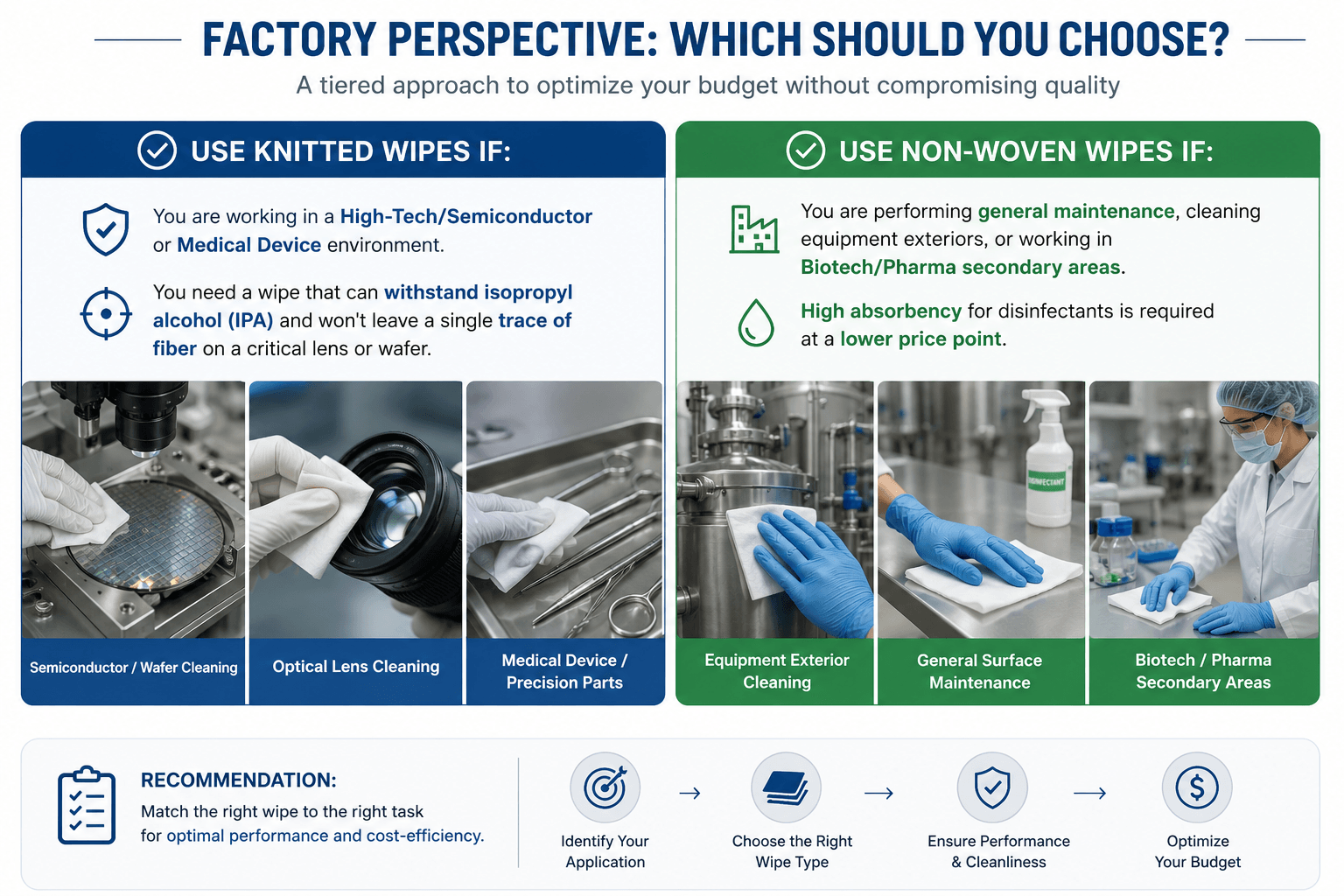
From a manufacturing standpoint, we recommend a tiered approach to optimize your budget without compromising quality:
Use Knitted Wipes if: You are working in a High-Tech/Semiconductor or Medical Device environment. You need a wipe that can withstand isopropyl alcohol (IPA) and won't leave a single trace of fiber on a critical lens or wafer.
Use Non-Woven Wipes if: You are performing general maintenance, cleaning equipment exteriors, or working in Biotech/Pharma secondary areas where high absorbency for disinfectants is required at a lower price point.
By selecting the correct material, you ensure both the integrity of your product and the efficiency of your cleanroom operations.