


In the daily maintenance and precision manufacturing of a cleanroom, a tiny wiping tool often determines the final yield rate of a product. As factory managers or procurement specialists, we know exactly how difficult it is to find the balance between "compliance" and "efficiency."
Oftentimes, contamination issues on the production line are not caused by process negligence, but rather by choosing the wrong Cleanroom Swabs. Today, from a practical factory floor perspective, we will discuss the five most common pitfalls to avoid when selecting cleanroom swabs.
1. Material Selection Blindness: Foam vs. Polyester
The most frequent mistake is assuming one material fits all. Many factories try to standardize a single type of swab to save costs, but this is where hidden risks begin.
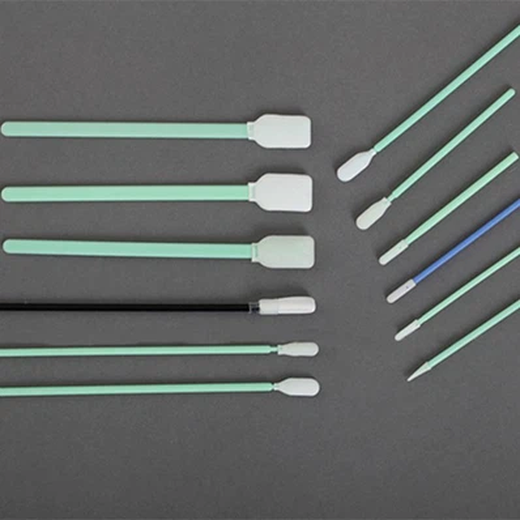
Foam Tips: These offer excellent liquid sorbency, making them ideal for applying solvents or picking up spills. However, traditional polyurethane foam may swell or degrade when exposed to harsh solvents like acetone.
Polyester Tips: Constructed from continuous-filament yarns, these are highly abrasion-resistant and offer broad chemical compatibility. If you are cleaning rough surfaces or using aggressive chemicals, polyester is the more reliable choice.

2. Overlooking Chemical Compatibility
In a factory environment, the tip material must "get along" with your cleaning agents.
The Case: If you use Isopropyl Alcohol (IPA) with a foam swab, it generally performs well. However, if you use a low-end foam swab with high-corrosive solvents, the micro-cellular structure of the foam may break down. This leads to particle shedding, directly contaminating precision workpieces.
The Tip: Before bulk purchasing, always verify the chemical resistance chart. Ensure that the Cleanroom Swabs will not release Non-Volatile Residue (NVR) after contact with your specific solvents.
3. Focusing Only on Unit Price while Ignoring "Hidden Costs"
Low-quality swabs may seem cheap on a purchase order, but the consequences can be catastrophic:
Shedding: Fibers or particles falling off, leading to product rejection.
Cross-Contamination: Ionic contamination caused by inferior cleanroom packaging.
Low Efficiency: Poor absorbency means workers use more swabs to complete the same task, increasing waste.
Investing in high-quality Cleanroom Swabs is essentially buying insurance for your production yield.
4. Neglecting Handle Performance and Purity
Managers often focus on the "head" and forget the "handle."
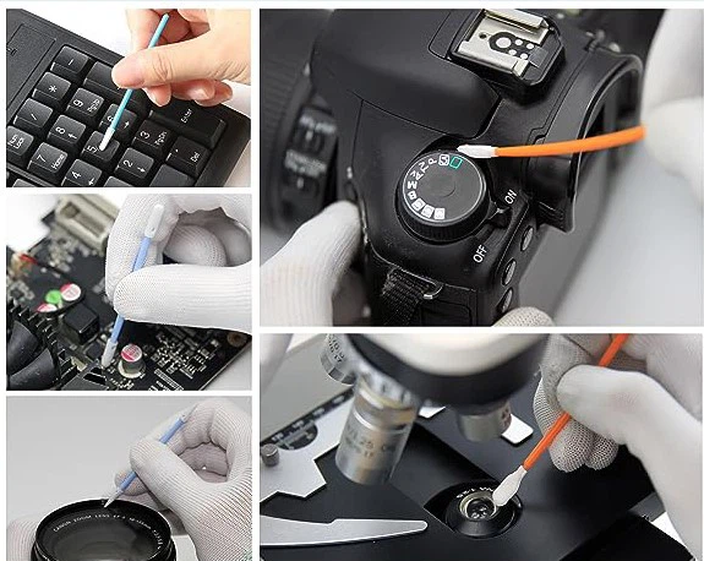
Material: Polypropylene (PP) handles are usually the preferred choice due to their low particle generation.
ESD Requirements: In semiconductor or microelectronics assembly, you must choose handles with Electrostatic Discharge (ESD) properties to prevent static damage to sensitive components.
5. The "Backward Compatibility" Myth of Cleanroom Grades
Some facilities use ISO Class 7 rated swabs in an ISO Class 5 environment, thinking, "as long as it looks clean, it's fine." In reality, if the particle release of the swab exceeds the environmental standard, the tool itself becomes the source of contamination.
There is no such thing as a "small detail" in cleanroom management. By understanding the characteristics of different materials (such as foam vs. polyester) and matching the right tools to your specific process, you can improve cleaning efficiency and significantly reduce the risk of contamination.
Advice: Before switching suppliers or models, always conduct a small-scale test in your actual production environment. Observing how a swab performs under your specific solvent exposure is more valuable than any datasheet.