


In a high-precision manufacturing environment, the smallest invisible threat can lead to the most significant losses. Electrostatic Discharge (ESD) is that silent predator. While most factories invest heavily in anti-static workstations and flooring, the most critical link in the chain is often the most overlooked: ESD Clothing.
Maintaining these specialized garments is not just about cleanliness; it is about preserving a technical barrier that protects your integrated circuits and sensitive components from catastrophic failure. Here is how professional facilities manage their protective apparel to ensure long-term compliance and safety.
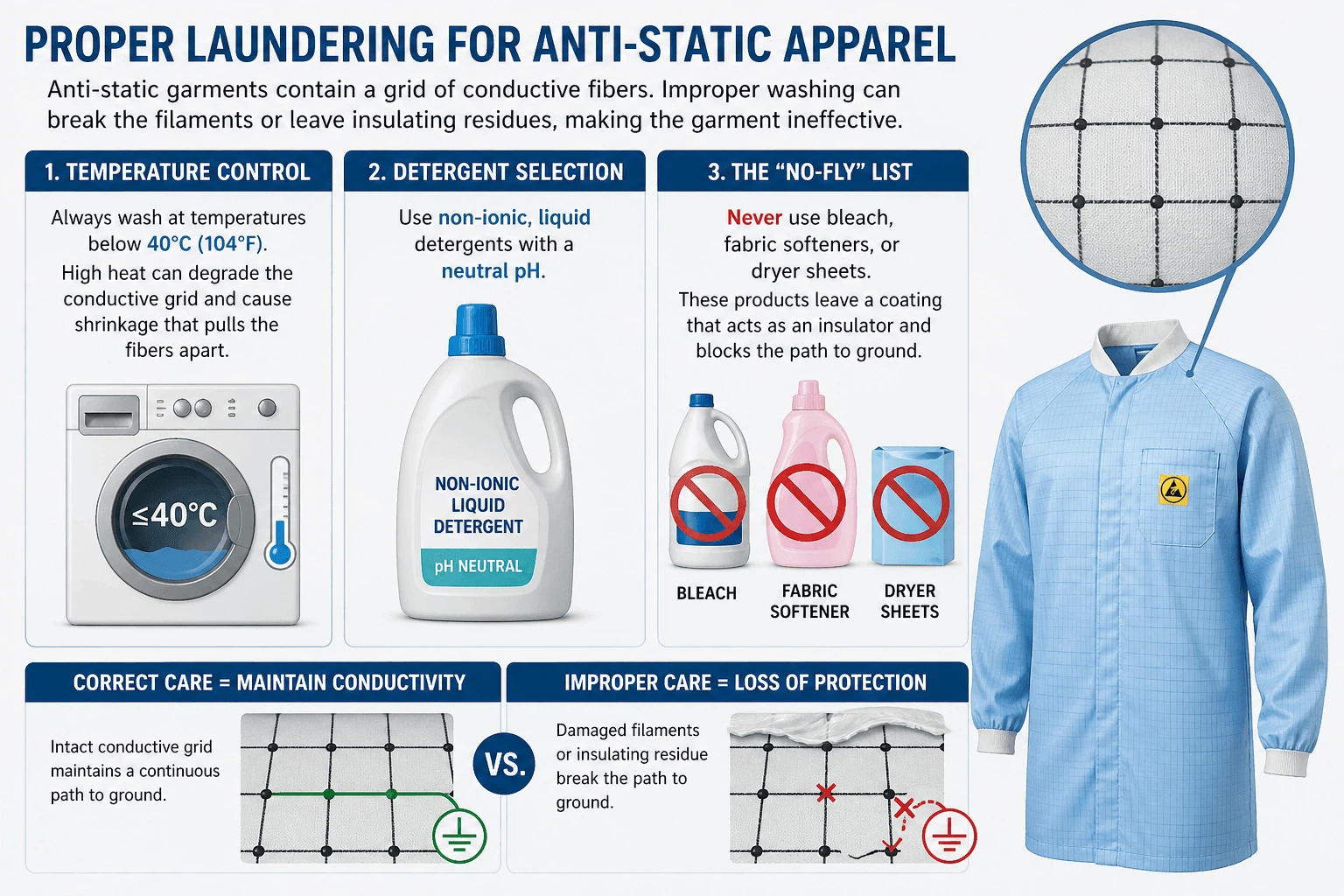
Unlike standard industrial uniforms, anti-static apparel contains a grid of conductive fibers (usually carbon or metal-infused). Improper laundering can break these filaments or coat them in insulating residues, rendering the garment useless.
- Temperature Control: Always wash at temperatures below 40°C (104°F). High heat can degrade the conductive grid and cause shrinkage that pulls the fibers apart.
- Detergent Selection: Use non-ionic, liquid detergents with a neutral pH.
- The "No-Fly" List: Never use bleach, fabric softeners, or dryer sheets. Softeners work by coating fibers in a thin layer of wax or silicone to make them feel soft-this layer is an insulator that blocks the path to ground.
The drying process is where many garments lose their longevity.
- Low Heat Only: If using a dryer, stick to the lowest heat setting or hang dry in a cleanroom-compatible environment. Overheating causes the synthetic polyester often found in ESD Clothing to become brittle.
- Airborne Particles: In Class 100 or Class 10 environments, garments should be dried using HEPA-filtered air to prevent the fabric from "trapping" particles during the drying phase.
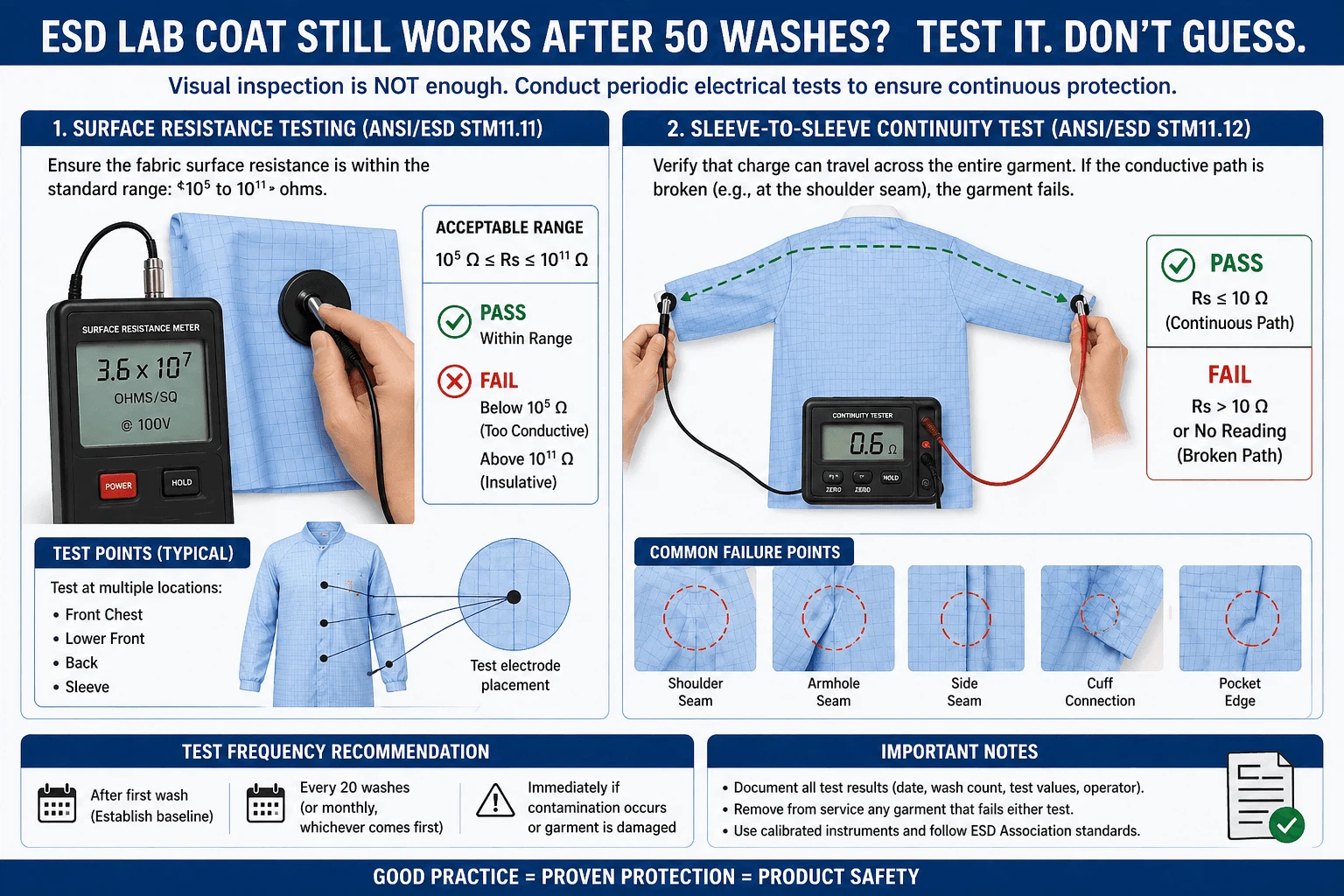
How do you know if a lab coat still works after 50 washes? You cannot tell by looking at it. A robust maintenance program must include periodic testing.
Surface Resistance Testing: Use a surface resistance meter to ensure the garment falls within the standard range (typically $10^5$ to $10^{11}$ ohms).
Sleeve-to-Sleeve Continuity: Ensure the charge can travel across the entire garment. If the conductive path is broken at the shoulder seam, the garment fails to protect the product.
Maintenance doesn't end when the laundry is done. How employees handle their ESD Clothing during shifts matters.
Avoid Personal Contamination: Discourage employees from wearing personal scarves or high-static sweaters over or under their anti-static gear if it interferes with the fit or grounding.
Dedicated Hanging: Store garments on grounded racks or in lockers that prevent contact with high-static materials like plastic bags or unshielded cardboard.
Consistency is the soul of quality control. By treating your protective apparel as a calibrated tool rather than just a uniform, you extend the life of your investment and, more importantly, safeguard your yield rates.
A well-maintained garment is the frontline defense for your electronics, ensuring that the "Ultimate Guide" to your facility's success isn't interrupted by a single stray spark.