


The 18th CIBF (China International Battery Fair) 2026 in Shenzhen has sent a clear signal to the world: the New Energy Vehicle (NEV) industry is no longer just in a race of "scale"; it has entered a deep-tier "war of craftsmanship."
As solid-state batteries move toward vehicle validation and sodium-ion batteries hit mass production, a harsh reality sets in: The more advanced the battery chemistry, the more "intolerant" it becomes of microscopic contaminants.
From "Lab Miracles" to "Production Reality"
As highlighted at CIBF 2026, reaching an energy density of 500Wh/kg is a triumph of science, but maintaining that density across millions of cells is a triumph of manufacturing.
In solid-state batteries, the contact between the electrolyte and the electrode is hypersensitive. A single stray fiber or a microscopic dust particle can increase interfacial impedance, leading to inconsistent performance or premature cell failure.
In the era of ultra-thin separators (< 5um), the margin for error has effectively vanished. What used to be a "negligible speck" is now a "safety hazard."

The High Cost of the "Small Problem"
In the current market, where delivery windows are tightening and storage battery demand is exploding, yield rate (ROI) is everything.
Oil residues on coating rollers, metal shavings from slitting processes, and lint from inferior cleaning wipes are not just "janitorial issues." They are "profit killers."
Every time a production line stops due to contamination-related defects, the hidden costs-lost time, wasted raw materials (like expensive PP and Lithium), and re-work-erode a company's competitive edge.
In the high-standard scenario of new energy battery manufacturing, wiping is no longer just as simple as "wiping clean".
If the wiping material drops debris, it may affect the clean environment;
Insufficient adsorption capacity, oil stains, liquids and residues need to be treated repeatedly;
Re-use of ordinary rags may bring the risk of cross-contamination;
The operation methods of different personnel are not uniform, which can easily cause fluctuations in the cleaning effect.
Therefore, wiping is becoming part of equipment maintenance, process cleaning, and manufacturing process management.
When the industry moves from "expanding production capacity" to "stable mass production", these high-frequency, basic, and easily overlooked actions need to be standardized and controllable.
Our Role: Engineering the "Zero-Contamination" Environment
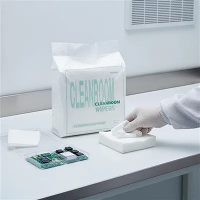
As a specialized manufacturer of cleanroom wipers and industrial consumables, we don't just see ourselves as suppliers; we are the guardians of the production line.
To meet the standards discussed at CIBF 2026, we have evolved our products into high-precision industrial tools:
- Zero-Linting Technology: Our laser-sealed and ultrasonic-edge polyester wipers ensure that the act of cleaning does not introduce new fibers into the CTP (Cell-to-Pack) or CTC (Cell-to-Chassis) assembly process.
- Chemical Purity: Our materials are processed to be ultra-low in metallic ions (Na+, K+, Ca2+), preventing the "invisible" chemical interference that can destabilize high-nickel cathode systems.
- Standardized Precision: Just as BMS (Battery Management Systems) standardize cell output, our professional wiping solutions standardize the cleaning process, ensuring that every operator on every shift achieves the same level of surface purity.

For new energy battery manufacturing companies, cleaning and wiping are not corner work, but an important basis for ensuring equipment stability, process stability and delivery stability. Qianyu will continue to use professional wiping solutions to help manufacturing companies make the basic actions of cleaning, maintenance and on-site management more efficient, stable and controllable.