


In the world of high-tech manufacturing-whether it's semiconductors, aerospace, or medical devices-the margin for error has shrunk to the sub-micron level. Yet, a strange paradox exists in many procurement departments: they will invest millions in state-of-the-art lithography or vacuum systems, then attempt to save a few cents on the very tool used to keep those systems clean-the humble cleanroom wiper.
If you are evaluating your consumables based on price per pack, you aren't just looking at the wrong metric; you are potentially inviting a financial disaster.
When choosing cleanroom wipers, many procurement teams look at the price per pack. But the real cost is measured in LPC (Liquid Particle Counts) and NVR (Non-Volatile Residues).
On a balance sheet, all wipers look like a line item. Under a microscope, they are vastly different.
- LPC (Liquid Particle Counts): A budget wiper often releases a "snowstorm" of micro-particles the moment it's saturated with IPA. These particles don't just stay on the cloth; they migrate to your silicon wafers or optical lenses.
- NVR (Non-Volatile Residue): This is the "ghost" in the machine. Cheap wipers often contain trace oils or chemical surfactants from the manufacturing process. When you wipe a surface, you might be leaving behind a molecular film that causes catastrophic adhesion failures in later stages.
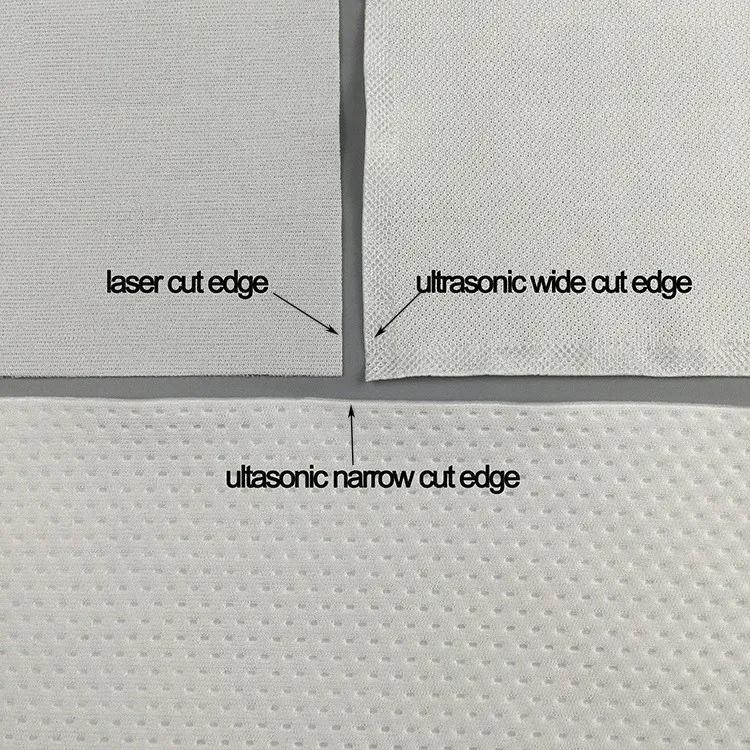
One of the easiest ways to lower manufacturing costs is to use a "cold-cut" (mechanical) edge. While these are fine for a garage or a low-grade industrial lab, using them in an ISO Class 5 or 6 environment is a gamble. Without the thermal sealing of a laser or the precision of an ultrasonic border, the edges of the wiper are essentially "frayed" at a microscopic level. As you apply pressure to wipe a corner, those loose fibers break off. The 10% you saved on the purchase price is instantly wiped out (pun intended) by a single batch of rejected components.
Let's do the math that procurement often misses. If a pack of premium, laser-sealed, laundered wipers costs $5 more than the budget version, but prevents just one batch rejection per month, the ROI is astronomical. In industries where a single wafer or a specialized sensor can be worth tens of thousands of dollars, a wiper that sheds even a few fibers isn't a "saving"-it's a liability.
At Xiamen Qianyu Technology, we emphasize the importance of Laser-Sealed Edges, Ultrasonc Sealed Edges. This technology fuses the fibers at the border, virtually eliminating linting during heavy-duty wiping. We guarantee that the laundry water used to wash those wipers was deionized to 18 MΩ. We provide the validation data and COA (Certificate of Analysis) that protect you during a quality audit.
Don't just buy a cloth; buy a contamination control solution.